
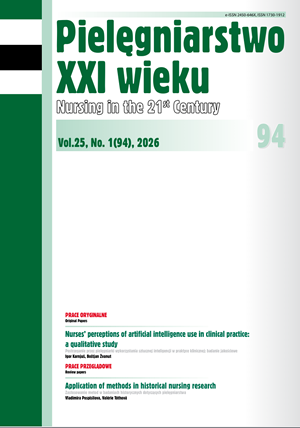
Postrzeganie przez pielęgniarki wykorzystania sztucznej inteligencji w praktyce klinicznej: badanie jakościowe
DOI:
https://doi.org/10.12923/pielxxiw-2026-0002Słowa kluczowe:
pielęgniarstwo, grupy fokusowe, sztuczna inteligencja, postrzeganieAbstrakt
POSTRZEGANIE PRZEZ PIELĘGNIARKI WYKORZYSTANIA SZTUCZNEJ INTELIGENCJI W PRAKTYCE KLINICZNEJ: BADANIE JAKOŚCIOWE
Cel pracy. Wykorzystanie sztucznej inteligencji (AI) budzi szereg wątpliwości dotyczących jej wpływu na pielęgniarstwo i ogólnie na opiekę zdrowotną. Do tej pory nie poświęcano zbyt wiele uwagi opiniom praktykujących pielęgniarek na temat wykorzystania tej technologii, co pozostawia lukę badawczą w tej dziedzinie. Niniejsze badanie miało na celu zbadanie aktualnych opinii pielęgniarek na temat wykorzystania AI w ich zawodzie oraz przeanalizowanie związanych z tym korzyści i kwestii etycznych związanych z tą innowacją technologiczną.
Materiał i metody. Zastosowano jakościowy, eksploracyjny projekt badawczy. Piętnaście słoweńskich pielęgniarek przedłożyło swoje pisemne refleksje i wzięło udział w dwóch grupach fokusowych poświęconych temu tematowi.
Wyniki. Zidentyfikowano trzy następujące tematy: ograniczenia sztucznej inteligencji (kategorie: empatia i komunikacja oraz rozumowanie kliniczne), potencjalne korzyści płynące ze sztucznej inteligencji (kategorie: wydajność pracy i poprawa pielęgniarstwa jako dyscypliny) oraz kwestie społeczne i zarządcze (kategorie: akceptacja sztucznej inteligencji oraz wdrażanie i wykorzystanie).
Wnioski. Zidentyfikowane tematy i kategorie kierują procesem wdrażania innowacji AI w pielęgniarstwie i odzwierciedlają jego specyfikę. Ponadto podkreślają one potrzebę zmiany paradygmatu w pielęgniarstwie, której można się spodziewać wraz z wykorzystaniem tej technologii w klinicznej praktyce pielęgniarskiej.
Bibliografia
1. Buchanan C, Howitt ML, Wilson R, et al. Predicted Influences of Artificial Intelligence on Nursing Education: Scoping Review. JMIR Nurs. 2021;4:e23933. https://doi.org/10.2196/23933
2. Jiang F, Jiang Y, Zhi H, et al. Artificial intelligence in healthcare: past, present and future. Stroke Vasc. Neurol. 2017;2:23-243. https://doi.org/10.1136/svn-2017-000101
3. Seibert K, Domhoff D, Bruch D, et al. Application scenarios for artificial intelligence in nursing care: rapid review. J. Med. Internet Res. 2021;23:e26522. https://doi.org/10.2196/26522
4. Esmaeilzadeh P. Use of AI-based tools for healthcare purposes: a survey study from consumers’ perspectives. BMC Med. Inform. Decis. Mak. 2020;20:170. https://doi.org/10.1186/s12911-020-01191-1
5. Robert N. How artificial intelligence is changing nursing. Nurs. Manag. (Harrow). 2019;50:30-39. https://doi.org/10.1097/01.NUMA.0000578988.56622.21
6. Benke K, Benke G. Artificial Intelligence and big data in public health. Int. J. Environ. Res. Public Health. 2018;15:2796. https://doi.org/10.3390/ijerph15122796
7. Cramer Em, Seneviratne Mg, Sharifi H, et al. Predicting the incidence of pressure ulcers in the intensive care unit using machine learning. EGEMS Wash DC. 2019;7:49. https://doi.org/10.5334/egems.307
8. Marschollek M, Wolf Kh, Gietzelt M, et al. Assessing elderly persons’ fall risk using spectral analysis on accelerometric data--a clinical evaluation study. Annu. Int. Conf. IEEE Eng. Med. Biol. Soc. IEEE Eng. Med. Biol. Soc. Annu. Int. Conf. 2008. https://doi.org/10.1109/IEMBS.2008.4650008
9. Pepito JA, Locsin R. Can nurses remain relevant in a technologically advanced future? Int. J. Nurs. Sci. 2019;6:106-110. https://doi.org/10.1016/j.ijnss.2018.09.013
10. Maalouf N, Sidaoui A, Elhajj IH, et al. Robotics in nursing: a scoping review. J. Nurs. Scholarsh Off Publ. Sigma Theta Tau. Int. Honor. Soc. Nurs. 2018;50:590-600. https://doi.org/10.1111/jnu.12424
11. Stokes F, Palmer A. Artificial Intelligence and robotics in nursing: ethics of caring as a guide to dividing tasks between AI and humans. Nurs. Philos. Int. J. Healthc. Prof. 2020;21. https://doi.org/10.1111/nup.12306
12. von Gerich H, Moen H, Block LJ, et al. Artificial Intelligence -based technologies in nursing: A scoping literature review of the evidence. Int. J. Nurs. Stud. 2022;127:104153. https://doi.org/10.1016/j.ijnurstu.2021.104153
13. Curtis K. Compassion is an essential component of good nursing care and can be conveyed through the smallest actions. Evid. Based Nurs. 2015;18:95. https://doi.org/10.1136/eb-2014-102025
14. Sharp S, McAllister M, Broadbent M. The vital blend of clinical competence and compassion: How patients experience person-centred care. Contemp. Nurse. 2016;52. https://doi.org/10.1080/10376178.2015.1020981
15. Perez-Bret E, Altisent R, Rocafort J. Definition of compassion in healthcare: a systematic literature review. Int. J. Palliat. Nurs. 2016;22. https://doi.org/10.12968/ijpn.2016.22.12.599
16. Davis FD, Bagozzi RP, Warshaw PR. User acceptance of computer technology: a comparison of two theoretical models. Manag. Sci. 1989;35:982-1003. https://doi.org/10.1287/mnsc.35.8.982
17. Venkatesh V, Davis FD. A Model of the antecedents of perceived ease of use: development and test. Decis. Sci. 1996;27:451-481. https://doi.org/10.1111/j.1540-5915.1996.tb01822.x
18. Venkatesh V, Davis FD. A Theoretical extension of the technology acceptance model: four longitudinal field studies. Manag. Sci. 2000;46:186-204. https://doi.org/10.1287/mnsc.46.2.186.11926
19. Rogers EM. Diffusion of innovations. 5th ed. New York: Free Press; 2003.
20. Venkatesh V, Morris MG, Davis GB, et al. User acceptance of information technology: toward a unified view. MIS Q. 2003;27:425-478. https://doi.org/10.2307/30036540
21. Johnson DG, Verdicchio M. The sociotechnical entanglement of AI and values. AI Soc 2025;40:67-76. https://doi.org/10.1007/s00146-023-01852-5
22. Elo S, Kyngäs H. The qualitative content analysis process. J. Adv. Nurs. 2008;62:107-115. https://doi.org/10.1111/j.1365-2648.2007.04569.x
23. Blease C, Bernstein MH, Gaab J, et al. Computerization and the future of primary care: A survey of general practitioners in the UK. PLOS ONE. 2018;13:e0207418. https://doi.org/10.1371/journal.pone.0207418
24. Blease C, Kaptchuk TJ, Bernstein MH, et al. Artificial Intelligence and the future of primary care: exploratory qualitative study of uk general practitioners’ views. J. Med. Internet Res. 2019;21:e12802. https://doi.org/10.2196/12802
25. Abuzaid MM, Elshami W, Fadden SM. Integration of artificial intelligence into nursing practice. Health Technol. 2022;12:1109-1115. https://doi.org/10.1007/s12553-022-00697-0
26. Davis FD. Perceived usefulness, perceived ease of use, and user acceptance of information technology. MIS Q. 1989;13:319-340. https://doi.org/10.2307/249008
27. Petitgand C, Motulsky A, Denis J-L, et al. Investigating the barriers to physician adoption of an artificial intelligence- based decision support system in emergency care: an interpretative qualitative study. Digit. Pers. Health Med. IOS Press; 2020, p. 1001-1005. https://doi.org/10.3233/SHTI200312
28. Sandhu S, Lin AL, Brajer N, et al. Integrating a machine learning system into clinical workflows: qualitative study. J. Med. Internet Res. 2020;22:e22421. https://doi.org/10.2196/22421
29. Coffetti E, Paans W, Roodbol PF, et al. Individual and team factors influencing the adoption of information and communication technology by nurses: a systematic review. CIN Comput. Inform. Nurs. 2023;41:205-214. https://doi.org/10.1097/CIN.0000000000000931
30. Hamedani Z, Moradi M, Kalroozi F, et al. Evaluation of acceptance, attitude, and knowledge towards artificial intelligence and its application from the point of view of physicians and nurses: A provincial survey study in Iran: A cross‐sectional descriptive‐analytical study. Health Sci. Rep. 2023;6:e1543. https://doi.org/10.1002/hsr2.1543
31. Rodriguez‐Arrastia M, Martinez‐Ortigosa A, Ruiz‐Gonzalez C, et al. Experiences and perceptions of final‐year nursing students of using a chatbot in a simulated emergency situation: A qualitative study. J. Nurs. Manag 2022;30:3874-3884. https://doi.org/10.1111/jonm.13630
32. Rony MKK, Parvin MstR, Ferdousi S. Advancing nursing practice with artificial intelligence: Enhancing preparedness for the future. Nurs. Open. 2024;11:nop2.2070. https://doi.org/10.1002/nop2.2070
33. Zhang M, Scandiffio J, Younus S, et al. The adoption of AI in mental health care– perspectives from mental health professionals: qualitative descriptive study. JMIR Form. Res. 2023;7:e47847. https://doi.org/10.2196/47847
34. Laukka E, Hammarén M, Kanste O. Nurse leaders’ and digital service developers’ perceptions of the future role of artificial intelligence in specialized medical care: An interview study. J. Nurs. Manag. 2022;30:3838-3846. https://doi.org/10.1111/jonm.13769
35. Ronquillo CE, Peltonen L, Pruinelli L, et al. Artificial intelligence in nursing: Priorities and opportunities from an international invitational think‐tank of the Nursing and Artificial Intelligence Leadership Collaborative. J. Adv. Nurs. 2021;77:3707-3717. https://doi.org/10.1111/jan.14855
36. Hlávka JP. Security, privacy, and information-sharing aspects of healthcare artificial intelligence. Artif. Intell. Healthc., Elsevier; 2020, p. 235-270. https://doi. org/10.1016/B978-0-12-818438-7.00010-1
37. Ahmed MI, Spooner B, Isherwood J, et al. A systematic review of the barriers to the implementation of artificial intelligence in healthcare. Cureus. 2023. https://doi.org/10.7759/cureus.46454
38. Stinder AK, Frische A-M, Schilberg D. How can robotics be integrated into the field of care and acceptance by the population for the use of artificial intelligence be strengthened? In: Karwowski W, Ahram T, Nazir S, ed. Adv. Hum. Factors Train. Educ. Learn. Sci., vol. 963, Cham: Springer International Publishing; 2020, p. 85-94. https://doi.org/10.1007/978-3-030-20135-7_8
39. Senthilkumar T, Arumugam T, Pandurangan H, et al. Adoption of artificial intelligence in health care: A nursing perspective. Salud. Cienc. Tecnol. 2023;3:510. https://doi.org/10.56294/saludcyt2023510
40. Martinez-Ortigosa A, Martinez-Granados A, Gil-Hernández E, et al. Applications of Artificial intelligence in nursing care: A systematic review. J. Nurs. Manag. 2023;2023:1-12. https://doi.org/10.1155/2023/3219127
41. Raymond L, Castonguay A, Doyon O, et al. Nurse practitioners’ involvement and experience with AI-based health technologies: A systematic review. Appl. Nurs. Res. 2022;66:151604. https://doi.org/10.1016/j.apnr.2022.151604
42. Gannod GC, Abbott KM, Van Haitsma K, et al. A machine learning recommender system to tailor preference assessments to enhance person-centered care among nursing home residents. The Gerontologist. 2019;59:167-176. https://doi.org/10.1093/geront/gny056
43. Moser EC, Narayan G. Improving breast cancer care coordination and symptom management by using AI driven predictive toolkits. The Breast. 2020;50:25-29. https://doi.org/10.1016/j.breast.2019.12.006
44. Sahoo SK, Choudhury BB. Challenges and opportunities for enhanced patient care with mobile robots in healthcare. J. Mechatron. Artif. Intell. Eng. 2023;4:83-103. https://doi.org/10.21595/jmai.2023.23410
45. McGreevey JD, Hanson CW, Koppel R. Clinical, legal, and ethical aspects of artificial intelligence–assisted conversational agents in health care. JAMA. 2020;324:552. https://doi.org/10.1001/jama.2020.2724
46. Lee D, Yoon SN. Application of artificial intelligence-based technologies in the healthcare industry: opportunities and challenges. Int. J. Environ. Res. Public Health. 2021;18:271. https://doi.org/10.3390/ijerph18010271
47. Buchanan C, Howitt ML, Wilson R, et al. Predicted influences of artificial intelligence on the domains of nursing: scoping review. JMIR Nurs. 2020;3:e23939. https://doi. org/10.2196/23939
48. Chen M, Decary M. Artificial intelligence in healthcare: An essential guide for health leaders. Healthc. Manage. Forum. 2020;33:10-18. https://doi.org/10.1177/0840470419873123
49. Al-Ruwaili MD, Al-Anzi AA-H, Al-Gaisi FFG, et al. The Role of technology in enhancing collaboration between nurses and healthcare assistants in improving healthcare delivery and promoting sustainability in health systems. J. Int. Crisis. Risk. Commun. Res. 2024;7:905-911. https://doi.org/10.63278/jicrcr.vi.2064
50. Khirfan R, Kotb H, Atiyeh H. Utilizing artificial intelligence to improve patient safety: innovations, obstacles, and future paths. Res. J. Pharm. Technol. 2024:4630-4636. https://doi.org/10.52711/0974-360X.2024.00714
51. Taie ES, Ali FN. Artificial intelligence in nursing practice: challenges and barriers. Helwan. Int. J. Nurs. Res. Pract. 2024;3:217-230. https://doi.org/10.21608/hijnrp.2024.292923.1169
Pobrania
Opublikowane
Numer
Dział
Licencja
Prawa autorskie (c) 2026 Igor Karnjuš, Boštjan Žvanut (Autor)

Utwór dostępny jest na licencji Creative Commons Uznanie autorstwa 4.0 Międzynarodowe.